What is a Backflow Preventer?

Everything property owners need to know about certified annual backflow testing, municipal compliance, common failures, repair options, and protecting drinking water in British Columbia.
πŸ“– 12 Minute Read

Introduction

Annual backflow testing is one of the most important steps in protecting your property's drinking water system and maintaining municipal compliance. Whether you own a commercial building, manage a strata corporation, operate an industrial facility, or maintain an irrigation system, annual testing helps verify that your backflow preventer continues operating correctly and protecting the public water supply.

This guide explains everything you need to know about annual backflow testing, including why it is required, who needs it, how the testing process works, what happens if a device fails, how municipal reporting works, and how to stay compliant with your local Cross Connection Control Program.

Need certified annual backflow testing? Request a Quote or Contact 123 Backflow.

What You'll Learn

By the end of this guide you'll understand:
βœ… What annual backflow testing is
βœ… Why municipalities require annual testing
βœ… Who needs annual backflow testing
βœ… What happens during the testing process
βœ… How long backflow testing takes
βœ… Common reasons a backflow preventer fails
βœ… How repairs and re-certification work
βœ… How municipal reporting works
βœ… What annual backflow testing usually costs
βœ… How to prepare for your annual test
βœ… Frequently asked questions from property owners

Quick Answer

Annual backflow testing is a certified inspection performed on a testable backflow prevention assembly to verify that it continues operating correctly. During the inspection, a certified backflow tester uses calibrated differential pressure testing equipment to measure the performance of the device's internal components. If the assembly passes, the required municipal report is completed and submitted. If it fails, repairs or replacement may be recommended before the device is re-tested and certified.

What is Annual Backflow Testing?

Annual backflow testing is a certified performance test that confirms a backflow prevention assembly continues operating as designed. Unlike a simple visual inspection, annual testing evaluates the internal working components of the device using specialized differential pressure testing equipment. The goal is to verify that the assembly can prevent contaminated water from flowing backward into the public drinking water system.

Backflow prevention assemblies are mechanical devices. Like any piece of mechanical equipment, their internal components naturally wear over time. Springs lose tension, rubber seals deteriorate, check valves become obstructed by debris, and relief valves may no longer operate within manufacturer specifications. These problems often develop gradually and cannot be identified by simply looking at the device from the outside.

Annual testing allows certified backflow testers to identify these issues before they create a risk to the drinking water system. The test results help confirm that the assembly continues to protect against backflow while meeting the performance standards required by municipal Cross Connection Control Programs.

Most municipalities throughout Metro Vancouver and the Fraser Valley require annual testing for commercial, industrial, institutional, irrigation, and many multi-family residential properties equipped with testable backflow prevention assemblies. Once the inspection has been completed, the certified test results are submitted to the municipality to maintain compliance with local requirements.

Regular testing not only helps satisfy municipal requirements but also gives property owners confidence that their plumbing system continues to protect building occupants and the public water supply from potential contamination.

πŸ’‘ Did You Know?

A backflow preventer can appear normal from the outside while still failing its certified performance test. Internal check valves, springs, seals, and relief valves can fail without obvious external warning signs.

That is why annual testing is required even when the device is not visibly leaking.

Why Is Annual Backflow Testing Required?

Annual backflow testing is required because backflow prevention devices protect more than a single property. They help protect the public drinking water system from contamination caused by cross connections. A cross connection is any point where potable drinking water could come into contact with a non-potable source, such as irrigation water, fire sprinkler water, boiler treatment chemicals, industrial process water, cleaning chemicals, or stagnant water.

When water flows in the correct direction, the risk is controlled. However, pressure changes can cause water to move backward. This can happen through back pressure or back siphonage. Back pressure occurs when pressure inside a private plumbing system becomes greater than the municipal supply pressure. Back siphonage occurs when the municipal pressure drops and water is pulled backward from a connected system.

Municipal Cross Connection Control Programs exist to reduce these risks. By requiring certified annual testing, municipalities can verify that installed backflow prevention assemblies continue to provide the level of protection originally required for the property.

Testing is especially important because many high-risk systems are common in commercial and multi-unit properties. Restaurants, warehouses, medical clinics, schools, irrigation systems, fire protection systems, industrial facilities, and strata buildings may all contain equipment or water systems that could create cross-connection hazards if not properly protected.

Comparison: Without Annual Testing

Without Annual Testing:
❌ Hidden internal failures may go undetected
❌ Municipal deadlines may be missed
❌ Repairs may be discovered too late
❌ Higher risk if a pressure event occurs
❌ Property owner may receive follow-up notices

Comparison: With Annual Testing

With Annual Testing:
βœ… Internal components are tested and verified
βœ… Compliance records are kept current
βœ… Wear and failure can be identified earlier
βœ… Device performance is confirmed annually
βœ… Report submission is completed after testing

Who Needs Annual Backflow Testing?

Annual backflow testing is commonly required for properties that contain testable backflow prevention assemblies. The exact requirements depend on the municipality, property use, hazard classification, and type of device installed. In general, properties with higher risk plumbing systems are more likely to require annual testing.

If you have received a municipal testing notice, your property likely has a device that must be tested by a certified backflow tester before the stated deadline. Even if you have not received a notice, a testable backflow assembly may still require annual certification depending on the municipality and installation.

πŸ’‘ Properties that commonly require annual testing include:

🏒 Commercial office buildings      
🍽️ Restaurants and food service businesses
πŸ“¦ Warehouses and distribution centres
🏭 Industrial and manufacturing facilities
🏘️ Strata corporations and multi-family residential buildings
πŸ₯ Medical and healthcare facilities
🏫 Schools and educational institutions
🏨 Hotels and hospitality properties
πŸ’¦ Irrigation systems and landscaped properties
🌾 Agricultural properties
πŸ”₯ Fire protection systems
πŸ›οΈ Retail plazas and mixed-use developments

Which Backflow Preventers Require AnnualΒ Testing?

Most backflow prevention assemblies require annual testing. A testable assembly is designed with test ports that allow a certified tester to connect calibrated equipment and measure performance. The device type installed depends on the hazard level, plumbing system, and municipal requirements.

πŸ’‘ Common Backflow Prevention Assemblies

Reduced Pressure Backflow Assembly (RPBA): Commonly used in high-hazard commercial, industrial, irrigation and specialized systems.

Double Check Valve Assembly (DCVA): Moderate-hazard application and some fire or domestic systems.

Pressure Vacuum Breaker (PVB): Irrigation and outdoor water systems in specific applications.

What Happens During a Backflow Test?

A certified backflow test follows an approved testing procedure for the specific type of assembly. While each device type has its own test method, the overall process is usually straightforward for the property owner.

1. Confirm access and device information: The technician locates the backflow preventer, confirms the device type, and checks whether the assembly is accessible and safe to test.
2. Perform a visual inspection: The assembly is inspected for leaks, damage, corrosion, missing components, improper installation, or access issues.
3. Temporarily isolate the assembly if required: Depending on the system and device type, the water supply may need to be briefly shut off while the test is completed.
4. Connect calibrated test equipment: The technician connects a calibrated differential pressure gauge to the device test ports.
5. Test the internal components: Check valves, relief valves, and pressure zones are tested according to approved procedures for the device type.
6. Record test results: The measured values are documented on the test report.
7. Explain results and next steps: If the device passes, the report is completed. If it fails, the technician explains the issue and repair options.
8. Submit the municipal report: The completed report is submitted to the appropriate municipality or reporting portal.

How Long does Annual Backflow Testing Take?

Most individual backflow preventer tests take approximately 20 to 45 minutes per device. The exact time depends on the type of assembly, size of the device, accessibility, system condition, and whether the water supply needs to be briefly interrupted.

A property with one accessible device may be completed quickly. Larger commercial properties, strata buildings, industrial facilities, or sites with multiple assemblies naturally require more time. If a device fails and repairs are required, the appointment may take longer or require a follow-up visit depending on parts availability and repair complexity.

πŸ’‘ What Affects Testing Time?

Number of Devices: More assemblies require more testing time.

Accessibility: Devices in mechanical rooms or tight spaces may take longer.

Device Condition: Leaks, seized valves, or damaged parts can slow the process.

Device Type: Different assemblies require different testing procedures.

Reporting Requirements: Municipal documentation adds administrative time.

What Happens If a Backflow Preventer Fails?

A failed backflow test does not automatically mean the device must be replaced. In many cases, the assembly can be repaired using manufacturer-approved parts before being re-tested and certified.

Common failure points include worn rubber components, weak springs, debris in check valves, leaking relief valves, damaged O-rings, or shut-off valves that do not operate properly. These issues are common because backflow preventers are mechanical devices exposed to pressure changes, mineral buildup, debris, weather, and normal aging.

When a device fails, the technician should explain what failed, why the assembly did not pass, and what repair options are available. After repairs are completed, the assembly is re-tested. A passing re-test is generally required before the final municipal report can be submitted as compliant.

**Replacement is not always the first solution. Many backflow preventers can be repaired and re-certified if the body of the assembly is in acceptable condition and replacement parts are available.

Common Reasons Backflow Preventers Fail

❌ Debris inside the assembly: Small particles, sediment, or scale can prevent check valves from sealing properly.
❌ Worn rubber seals: Rubber components wear down over time and may no longer provide a tight seal.
❌ Weak or damaged springs: Springs can lose tension and prevent internal components from operating correctly.
❌ Relief valve problems: On reduced pressure assemblies, relief valves may leak or fail to open at the required pressure differential.
❌ Freeze damage: Outdoor assemblies can be damaged if they are not properly protected during freezing weather.
❌ Improper installation: Insufficient clearance, incorrect orientation, or poor access can make testing and maintenance difficult.
❌ Aging components: Older assemblies may fail because internal parts have reached the end of their service life.

Backflow Repairs and Re-Certification

If a backflow preventer fails annual testing, repair and re-certification may be required. A proper repair should identify the failed component, use appropriate replacement parts, and include re-testing after the repair is complete.

Many common repairs involve rebuilding check valves, replacing seals, cleaning internal components, repairing relief valves, or replacing damaged springs. In some cases, shut-off valves or test cocks may also require attention. If the assembly is severely damaged, obsolete, incorrectly installed, or too costly to repair, replacement may be the better option.

After repairs are completed, the assembly must be tested again. The device is not considered certified until it passes the required testing procedure. Once the assembly passes, the report can be submitted to the municipality or reporting authority where applicable.

Municipal Report Submission

After annual backflow testing is complete, many municipalities require the certified test results to be submitted through a municipal reporting process or approved reporting platform. This report documents the device information, property information, test results, tester certification details, and whether the assembly passed or failed.

For property owners, report submission is often one of the most confusing parts of the process. Different municipalities may have different reporting requirements, deadlines, filing fees, or submission portals. That is why working with a company that handles municipal reporting can save time and reduce the risk of missed paperwork.

123 Backflow completes the required documentation and submits municipal reports where applicable. This helps property owners, strata managers, businesses, and facility managers stay compliant without having to navigate the reporting process themselves.

How Much Does Annual Backflow Testing Cost?

Annual backflow testing costs depend on several factors, including the number of devices, device size, accessibility, location, municipal reporting fees, and whether repairs are required. A single accessible assembly is usually less expensive to test than a property with multiple devices, large assemblies, difficult access, or failed components.

The best way to receive an accurate quote is to provide the property address, city, number of backflow preventers, and a copy of your municipal notice if available. Photos of the device can also help confirm the assembly type and access conditions.

πŸ’‘ Common Cost Factors

Number of Devices: Each assembly must be tested and documented.

Municipality: Some municipalities have separate reporting fees or portal requirements.

Accessibility: Hard to access devices may require additional time.

Repairs: Failed devices may require parts, labour, and re-testing.

Device Size and Type: Larger or more complex assemblies can take longer to test.

How to Prepare for Your Annual Backflow Test

A little preparation can make the appointment faster and smoother. Before your scheduled test, try to confirm where the backflow preventer is located and make sure the technician can access it. If the device is inside a locked mechanical room, underground box, parking area, utility room, or fenced enclosure, arrange access before the appointment.

If you received a municipal notice, keep it available. The notice may include device information, due dates, or account details needed for reporting. Photos of the assembly are also helpful if you are requesting a quote.

πŸ’‘ Helpful information to provide when booking

πŸ“Œ Property address
πŸ“Œ City or municipality
πŸ“Œ Number of backflow preventers
πŸ“Œ Copy of municipal notice if available
πŸ“Œ Photos of the device if possible
πŸ“Œ Device location, such as mechanical room, exterior or irrigation box.
πŸ“Œ Preferred appointment window

Need a Fast Quote?

To help us provide accurate pricing, send your property address, city, number of backflow preventers, and a photo or copy of your municipal notice if available. Most enquiries receive a response within 30 minutes during business hours.

Learning Centre

Related Learning Centre Articles

πŸ“Œ What Is a Backflow Preventer?
πŸ“Œ What Happens During a Backflow Test?
πŸ“Œ Backflow Preventer Repair Guide
πŸ“Œ Backflow Preventer Installation Guide
πŸ“Œ Backflow Testing Cost Guide
πŸ“Œ Cross Connection Control Explained
πŸ“Œ Backflow Testing Requirements in British Columbia

Is annual backflow testing mandatory?
Who is allowed to test a backflow preventer?
How long does annual backflow testing take?
Do I need to shut off my water during testing?
What happens if my backflow preventer fails?
Can the device be repaired during the same visit?
How often should a backflow preventer be tested?
Do you submit the municipal report?
What if I miss my municipal deadline?
Do residential homes need annual backflow testing?
What information do you need for a quote?
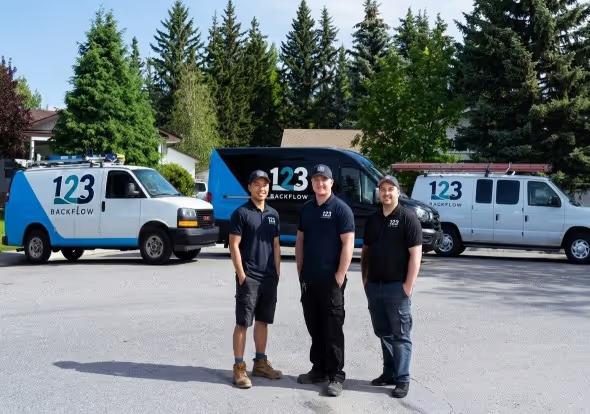
Three men in black company shirts standing in a parking lot with three white and blue vans labeled '123 BACKFLOW' in the background.
Book today and stay compliant.

Received a Backflow Testing Notice?

Portrait of a man with short black hair, smiling slightly against a dark blue background.

Have questions about annual testing, city notices, repairs, or installations? Contact Joseph directly for fast, knowledgeable assistance.