Cross Connection Control Explained

πŸ“– 25 Minute Read

Introduction

Cross connection control is the coordinated practice of identifying connections that could allow contaminants to enter a drinking water system, assessing the hazard created by those connections, installing appropriate protection, testing and maintaining that protection, and keeping records so the risk remains controlled over time. It is broader than annual backflow testing. Testing is one important part of a complete cross connection control program, but a strong program also includes surveys, hazard assessments, permits, device registration, repairs, reporting, enforcement, and public education.

A cross connection can exist anywhere potable water piping is connected, directly or indirectly, to equipment, chemicals, non-potable water, process piping, irrigation systems, fire protection systems, boilers, tanks, pools, or other sources that could affect water quality. Under normal operating conditions, water flows in the intended direction and the connection may appear harmless. The danger develops when pressure changes reverse that flow.

What You'll Learn

By the end of this guide you'll understand:
βœ… What a CCC program is designed to accomplish
βœ… How CCC fits into the BC regulatory framework
βœ… The lifecycle of a community CCC program
βœ… Roles of the water supplier, owner, tester, plumber, and designer
βœ… Cross connection surveys and hazard assessments
βœ… Device registration, inventories, and annual notices
βœ… Premises changes that trigger reassessment
βœ… How backflow occurs: backpressure and backsiphonage
βœ… Direct, indirect, actual, and potential cross connections
βœ… How hazard level affects protection
βœ… Premises isolation and in-premises protection
βœ… Testable assemblies versus non-testable devices
βœ… How the correct protection method is selected
βœ… Common misconceptions about cross connection control

Quick Answer

A CCC program is the organized process that makes sure cross connections are identified, protected, tested, repaired, reported, and trackedβ€”not just once, but throughout the life of the property and water system.

What Is a Cross Connection Control Program?

A cross connection control program is the administrative and technical system used by a water supplier, municipality, institution, or large facility to identify backflow risks and keep those risks controlled over time. The program converts plumbing-code principles into an ongoing process: find hazards, determine required protection, register testable assemblies, notify responsible parties, verify testing, require repairs, and maintain records.

The program is often called a CCC program. It may be operated by a municipality, regional district, utility, campus, health-care facility, industrial site, or another water-system owner. Program scope varies. Some focus primarily on premises-isolation assemblies at commercial and multi-family properties. More comprehensive programs also address in-premises hazards, temporary connections, hydrant use, non-testable devices, alternate water systems, and periodic resurveying.

What a CCC Program Is Designed to Accomplish

πŸ“Œ Protect the public drinking-water distribution system from contamination originating on customer properties.
πŸ“Œ Protect occupants and internal potable piping by identifying hazardous in-premises connections.
πŸ“Œ Create a reliable inventory of testable backflow prevention assemblies.
πŸ“Œ Verify that required assemblies are tested when installed and at the interval required by the authority.
πŸ“Œ Ensure failed assemblies are repaired or replaced and then re-tested.
πŸ“Œ Track property ownership, tenant use, device location, test status, and outstanding deficiencies.
πŸ“Œ Provide consistent procedures for permits, notices, forms, fees, enforcement, and public education.
πŸ“Œ Support incident response by showing where hazards and protective assemblies are located.

Cross Connection Control in British Columbia

In British Columbia, drinking-water protection uses a source-to-tap approach involving water suppliers, provincial drinking-water oversight, building and plumbing requirements, and local bylaws or utility programs. A water supplier may be required to establish cross connection controls through regulatory direction or a system assessment and response plan. Local governments and water suppliers commonly implement the detailed requirements through waterworks bylaws, building bylaws, standards, permit conditions, policies, and CCC program procedures.

The BC Water & Waste Association administers backflow tester certification and supports community CCC programs in British Columbia and the Yukon. Certified testers use recognized procedures and calibrated equipment to test assemblies and complete the records required by the local program. Local requirements can differ significantly: one authority may use an online portal, another a paper report, and another a third-party reporting system. Fees, deadlines, permit numbers, and accepted forms can also differ.

The CCC Program Lifecycle

1. Establish authority through a bylaw, policy, operating permit, code requirement, or water-supply condition.
‍2. Identify properties, occupancies, and water uses that may create cross connection hazards.
‍3. Conduct a survey or require property information to determine the type and degree of hazard.
‍4. Specify premises-isolation and in-premises protection where required.
‍5. Require permits, installation standards, initial testing, and registration of testable assemblies.
‍6. Maintain a device and property inventory with responsible-party contact information.
7.
Issue annual or periodic notices and track due dates.
‍8. Receive test reports, review failures, and require corrective action.
‍9. Confirm repair or replacement through a passing re-test.
‍10. Resurvey when ownership, occupancy, equipment, plumbing, or water use changes.
‍11. Use reminders, escalation, inspections, service restrictions, penalties, or other authorized measures to address non-compliance.
‍12. Review program data to improve risk prioritization, education, and system protection.

Who Is Responsible for What?

Water supplier or municipality
Operate the CCC program, establish local requirements, identify regulated properties, review surveys and reports, maintain records, and follow up on non-compliance.

Property owner
Provide access and accurate information, obtain permits, install required protection, arrange testing and repairs, pay applicable costs, and keep contact information current.

Strata corporation or property manager
Maintain a complete device inventory, coordinate notices and access, approve repairs, retain records, and ensure responsibilities do not fall between owners and tenants.

Certified backflow assembly tester
Identify the assembly, inspect the installation, perform the prescribed field test, record initial and final results, explain failures, re-test after repairs, and submit or provide reports as required.

Plumber or qualified installer
Install or alter piping and backflow protection in accordance with permits, code, design, manufacturer instructions, and local requirements.

Engineer or qualified designer
Assess complex systems, hazard levels, hydraulic impacts, redundancy, drainage, fire-service implications, and engineered alternatives where required.

Tenant or facility operator
Disclose equipment and process changes, avoid unauthorized bypasses or hose connections, report leaks, and cooperate with shutdowns and access.

Building or plumbing official
Review permits, inspect installations, interpret applicable code requirements, and coordinate with the CCC program where responsibilities overlap.

What Happens During a Cross Connection Survey?

A cross connection survey is a systematic review of how potable water is used on a property. It may range from a questionnaire and service-entry review to a detailed inspection of mechanical rooms, tenant spaces, production areas, irrigation, fire protection, roof equipment, laboratories, kitchens, wash areas, and alternate water systems. The survey should reflect the actual occupancy and processes, not only the original building drawings.
‍
‍1. Confirm the water service arrangement, meter location, service size, and existing premises-isolation assembly.
‍2. Review the property type, occupancy, tenant uses, and processes that consume or connect to water.
‍3. Identify potable, non-potable, private, recycled, rainwater, well, fire, irrigation, and process piping systems.
‍4. Inspect equipment connections, hoses, tanks, chemical dispensers, boilers, pumps, and submerged outlets.
‍5. Determine whether backpressure, backsiphonage, or both are possible.
‍6. Assess the potential consequence if material enters potable piping.
‍7. Document existing air gaps, assemblies, devices, bypasses, and missing protection.
‍8. Verify accessibility, orientation, drainage, freeze protection, clearances, and testability.
‍9. Create corrective actions with priorities, responsible parties, and completion dates.
‍10. Update the device inventory and schedule initial or annual testing.

Assessment: From Connection to Correct Protection

What is connected to potable water?
Defines the possible contaminant or non-potable source.

Can backpressure occur?
Determines whether vacuum-breaker-only protection is unsuitable.

Can backsiphonage occur?
Identifies risk from submerged outlets, hoses, tanks, and supply-pressure loss.

What is the degree of hazard?
Drives the required level of protection.

Where could contamination travel?
Determines source, zone, tenant, building, or premises-isolation needs.

Is the present use likely to change?
Addresses tenant turnover, temporary equipment, seasonal use, and future hazards.

Can the proposed assembly be safely installed and serviced?
Confirms space, drainage, orientation, access, freeze protection, and shutdown planning.

What does the authority require?
Aligns the solution with current code, permit, bylaw, standard, and reporting procedures.
Device Registration and Inventory Management

A testable assembly should have a record that uniquely identifies it and connects it to the correct property, service, hazard, and reporting cycle. Incomplete records create missed tests, duplicate device entries, reports applied to the wrong assembly, and confusion after ownership or management changes.

Initial Testing and Annual Testing

Testable assemblies are commonly tested when installed, after relocation or replacement, after repair, and at the recurring interval required by the local authority. Many community programs require annual testing. The tester confirms identification and installation condition, uses a calibrated differential-pressure gauge, records the initial result, completes authorized repair if applicable, and records a final passing result.

A passing test verifies the assembly at the time of testing. It does not eliminate the need for future testing because debris, wear, freezing, pressure conditions, corrosion, unauthorized changes, or shutoff-valve problems can develop later.

How CCC Programs Address Non-Compliance

The response to an overdue test or unresolved hazard depends on the local bylaw and the risk. Programs may use courtesy reminders, formal notices, deadlines, inspection orders, reinspection fees, permit holds, penalties, service restrictions, or other authorized actions. Higher-hazard or repeatedly non-compliant properties may receive priority follow-up.

Property owners should contact the program rather than ignore a notice. Common issuesβ€”incorrect contact information, removed devices, duplicate records, access problems, ownership changes, or a planned replacementβ€”can often be resolved more efficiently when documented early.

Changes That Should Trigger a CCC Review

πŸ“Œ A new tenant or change in business use.
πŸ“Œ Installation or replacement of boilers, cooling towers, pumps, irrigation, pools, commercial appliances, chemical dispensers, laboratory equipment, or process machinery.
πŸ“Œ Addition of a private well, rainwater, reclaimed water, greywater, cistern, or other alternate source.
πŸ“Œ Fire protection alterations, antifreeze, foam, pumps, private hydrants, or service changes.
πŸ“Œ Building expansion, renovation, plumbing alteration, or service relocation.
πŸ“Œ A bypass, temporary hose, tanker fill, hydrant connection, or construction connection.
πŸ“Œ Repeated failed tests, relief-valve discharge, pressure complaints, or freeze damage.
πŸ“Œ Ownership, property-management, or strata-management changes.
πŸ“Œ Removal, relocation, or replacement of a registered assembly.

Common Cross Connection Examples

Homes and townhouses: Garden hoses, irrigation systems, boilers, water softeners, pools, hot tubs, private wells.
Strata and multi-family: Domestic service isolation, irrigation, pools, mechanical rooms, boilers, tenant equipment.
Restaurants: Chemical dispensers, dishwashing equipment, carbonators, mop sinks, hose reels, coffee equipment.
Commercial buildings: Cooling towers, boilers, irrigation, tenant fit-outs, janitorial equipment, fire systems.
Medical and dental: Sterilizers, aspirators, laboratory equipment, dialysis-related systems, dental units.
Industrial facilities: Process tanks, wash systems, plating, chemical feed, compressed air, pumps.
Agriculture: Irrigation, fertilizer or pesticide injection, livestock watering, private wells, washdown.
Fire protection: Wet, dry, pre-action, foam, antifreeze, private hydrant, and combined fire services.
Construction and temporary work: Hydrant use, temporary hoses, flushing, drain cleaning, tanker filling.
Alternative water systems: Rainwater, greywater, reclaimed water, cisterns, non-potable irrigation.

Why Cross Connection Control Matters

Modern water systems use multiple barriers to protect drinking water. Treatment and distribution safeguards protect the public supply before it reaches a property. Cross connection control protects the system at and within properties, where water is connected to equipment and processes that the water supplier cannot continuously observe. A single unprotected connection can create a pathway between potable water and fertilizers, cleaners, boiler treatment chemicals, stagnant water, bacteria, industrial fluids, or other contaminants.

CCC programs are designed to prevent contamination rather than wait for an incident. They recognize that pressure can change unexpectedly because of firefighting demand, a water-main break, pump operation, high-rise pressure zones, thermal expansion, equipment pressure, or a shutdown elsewhere in the system. Proper protection must work during those abnormal conditions, not only during routine water use.

πŸ’‘ Essential Cross Connection Control Vocabulary

Potable water: Water intended to be safe for drinking, food preparation, and other potable uses.
‍
Non-potable water: Water that is not intended or approved for drinking. It may be untreated, recycled, stagnant, contaminated, or used for a process.
‍
Cross connection: An actual or potential connection between potable water piping and a source that could impair water quality.
‍
Backflow: Unwanted reverse flow of water, liquid, gas, or another substance into potable water piping.
‍
Backpressure: Backflow caused when pressure on the downstream or non-potable side becomes greater than the potable supply pressure.
‍
Backsiphonage: Backflow caused when supply pressure falls below the pressure at the connected source, creating a siphoning effect.
‍
Hazard: The potential consequence if the substance or water at a cross connection enters the potable system.
‍
Premises isolation: Protection installed near the water service entrance to help prevent contamination on a property from reaching the public distribution system.
‍
In-premises or source isolation: Protection installed close to the specific fixture, appliance, equipment, zone, or process that creates the hazard.
‍
Backflow prevention assembly: A testable mechanical assembly with shutoff valves and test cocks that can be field tested using prescribed procedures.
‍
Backflow prevention device: A broader term that may include both testable assemblies and non-testable devices.
‍
CCC program: The policies, surveys, records, testing requirements, corrective actions, and administration used by a water supplier or authority to manage cross connection risks.

How Backflow Happens

Water normally moves from a higher-pressure supply toward a lower-pressure point of use. Backflow occurs when that pressure relationship reverses. The reversal may last only seconds, but that can be enough to draw or push a contaminant into potable piping. The two fundamental causes are backpressure and backsiphonage.

Backpressure

Backpressure occurs when pressure downstream of a cross connection becomes greater than the potable water pressure. The downstream pressure can then push water or another substance backward. Common sources include pumps, boilers, elevated tanks, thermal expansion, pressure-boosting systems, compressed-air systems, and process equipment.
πŸ“Œ A boiler or hydronic system operating above domestic water pressure.
πŸ“Œ A pump connected to irrigation, process, or private water piping.
πŸ“Œ An elevated tank or high-level process creating static head pressure.
πŸ“Œ Thermal expansion in a closed system without appropriate pressure control.
πŸ“Œ Industrial or laboratory equipment that can pressurize connected piping.

Backsiphonage

Backsiphonage occurs when pressure in potable piping drops below the pressure at the connected source. This can draw liquid through a hose, submerged outlet, chemical injector, tank connection, or other pathway. Supply pressure can fall during a water-main break, firefighting operation, high demand, pump shutdown, service interruption, or draining of piping at a lower elevation.
πŸ“Œ A garden hose left submerged in a bucket, pool, or pesticide sprayer.
πŸ“Œ A chemical dispenser with an unprotected water connection.
πŸ“Œ A tank fill line located below the tank overflow level.
πŸ“Œ An irrigation line exposed to soil, animal waste, or stagnant water.
πŸ“Œ A temporary hose connection used during construction, maintenance, or drain cleaning.

Direct Cross Connection

A direct cross connection is a physical connection between potable and non-potable systems or substances. Examples include a potable make-up line connected directly to a chemical tank, a boiler fill connection without suitable protection, or an interconnection between potable and reclaimed water piping.

Indirect Cross Connection

An indirect cross connection creates a pathway through an outlet, hose, fixture, or air space rather than a permanently joined pipe. A hose submerged in a mop bucket is a classic example. The potable faucet and hose become connected to the bucket contents if backsiphonage occurs.

Actual and Potential Cross Connections

An actual cross connection exists in the present configuration. A potential cross connection could be created by foreseeable use, a hose attachment, equipment change, bypass, temporary connection, or maintenance practice. CCC surveys consider both. A connection does not need to be actively contaminating the water at the time of inspection to require control.

πŸ’‘ Survey mindset

The correct question is not only β€œIs contamination happening now?”. It is β€œCould this arrangement create a pathway during a pressure reversal or foreseeable change in use?”.

Premises Isolation and In-Premises Isolation

Premises isolation is installed near the water service entrance to reduce the risk that contamination originating on a property will reach the public water main. It protects the water supplier and neighbouring customers from the collective hazard presented by the property. The required assembly is based on the assessed premises hazard and local program rules.

In-Premises or Source IsolationIn-premises protection is installed close to the fixture, appliance, branch, zone, or process that creates the cross connection. It protects occupants and internal potable piping from a specific hazard. Examples include protection at a boiler make-up connection, chemical dispenser, irrigation branch, laboratory fixture, or commercial appliance.

πŸ’‘ Why Both May be Required

Premises isolation does not automatically make every internal connection safe. It may prevent contaminants from leaving the property while still allowing contamination to spread within the building. Conversely, individual source protection may not address undocumented or future hazards elsewhere on the property. A comprehensive approach can require both boundary protection and protection at specific sources.

Testable Assemblies vs. Non-Testable Devices

A testable assembly includes test cocks and shutoff valves arranged so a certified tester can measure whether the internal components meet prescribed performance criteria. RP, DCVA, PVB, SVB, and related detector assemblies are common testable types. A non-testable device is evaluated by installation, condition, application, and replacement requirements rather than differential-pressure field testing.

CCC programs often maintain an inventory of testable assemblies because their ongoing performance must be verified. Non-testable devices remain important, but they may be managed through plumbing inspections, maintenance procedures, periodic replacement, or equipment-specific requirements instead of annual test reports.

How the Correct Protection Is Selected

1. Identify the actual or potential cross connection.
‍2. Determine whether backpressure, backsiphonage, or both can occur.
‍3. Identify the substance, process, water source, and potential consequence.
‍4. Classify the degree of hazard using the applicable standard and authority requirements.
‍5. Determine whether protection is needed at the service entrance, at the source, or at both locations.
‍6. Select a permitted air gap, assembly, or device suitable for the hazard and pressure condition.
‍7. Confirm orientation, elevation, drainage, clearance, freeze protection, accessibility, and permit requirements.
8. Complete initial testing where required, register the assembly, and establish future testing and maintenance.

πŸ’‘ Common Misconceptions

β€œA check valve is the same as a backflow preventer.”
A simple check valve may not provide the redundancy, relief function, testability, approval, or hazard protection required.

β€œIf water flows normally, the assembly is working.”
Normal forward flow does not prove the internal components will prevent reverse flow.

β€œOnly industrial properties have cross connections.”
Homes, irrigation systems, restaurants, strata buildings, boilers, pools, and ordinary hose connections can all create cross connections.

β€œA device installed years ago is permanently compliant.”
Use, hazard, code requirements, parts, installation condition, and annual test performance can change.

β€œAny plumber can submit every municipal backflow report.”
Testing and reporting commonly require an appropriately certified tester and the municipality’s current form or portal process.

Need a Fast Quote?

To help us provide accurate pricing, send your property address, city, number of backflow preventers, and a photo or copy of your municipal notice if available. Most enquiries receive a response within 30 minutes during business hours.

Learning Hub

Related Learning Hub Articles

πŸ“Œ What Is a Backflow Preventer?
πŸ“Œ What Happens During a Backflow Test?
πŸ“Œ Backflow Preventer Repair Guide
πŸ“Œ Backflow Preventer Installation Guide
πŸ“Œ Backflow Testing Cost Guide
πŸ“Œ Cross Connection Control Explained
πŸ“Œ Backflow Testing Requirements in British Columbia

What is cross connection control?
What is a cross connection?
What does CCC program mean?
Is backflow testing the same as cross connection control?
What causes backflow?
What is premises isolation?
Do I still need source protection if I have premises isolation?
Who decides which backflow preventer is required?
What is a cross connection survey?
When should a property be resurveyed?
Is an air gap better than a backflow preventer?
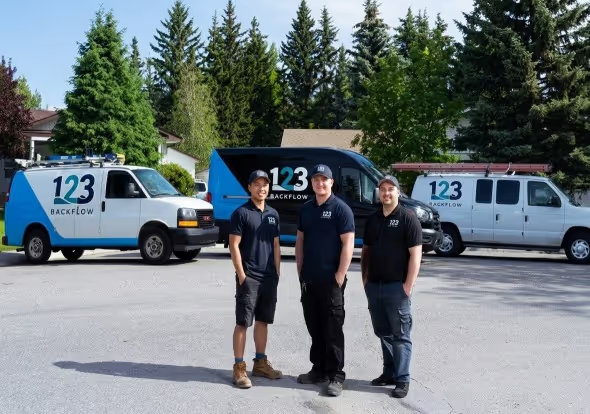
Three men in black company shirts standing in a parking lot with three white and blue vans labeled '123 BACKFLOW' in the background.
Book today and stay compliant.

Received a Backflow Testing Notice?

Portrait of a man with short black hair, smiling slightly against a dark blue background.

Have questions about annual testing, city notices, repairs, or installations? Contact Joseph directly for fast, knowledgeable assistance.